Two half-ton bulls. No matadors. No swords. Just horns, grit, and a crowd losing its mind in a concrete dome in the middle of Okinawa. Welcome to ushiorasee — and yes, it’s exactly as wild as it sounds.
So you’ve been on Okinawa for a while now. Maybe you’ve done the aquarium, hit the beaches, worked through the soba joints near your gate. But if you’ve never stood inside the Ishikawa Multipurpose Dome as two 1,000-kilogram bulls crash into each other like freight trains with horns, you’re missing what might be the most authentically Okinawan experience the island has to offer. Forget the souvenir shops. This one’s real.
This guide covers everything you need to know about Okinawan bullfighting — its history, how it works, what the locals get out of it, and how you, as an outsider, can get in the ring (metaphorically — please stay behind the fence) and actually appreciate what’s happening. And yes, there’s a full schedule and ticket prices at the bottom.
🐂 What Is Ushiorasee?
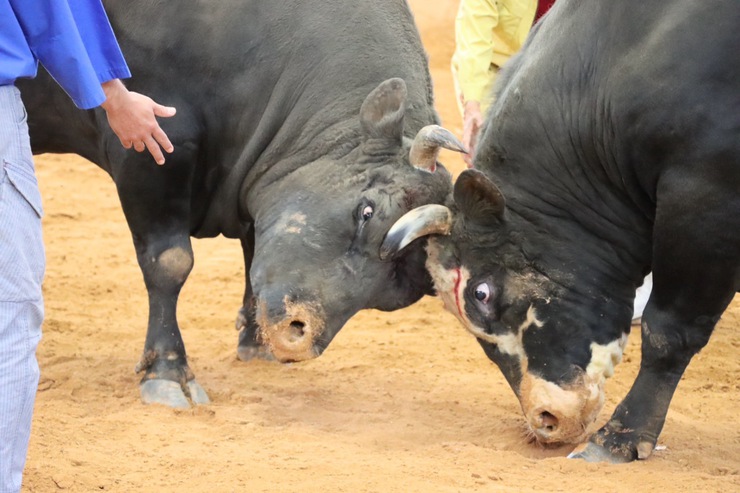
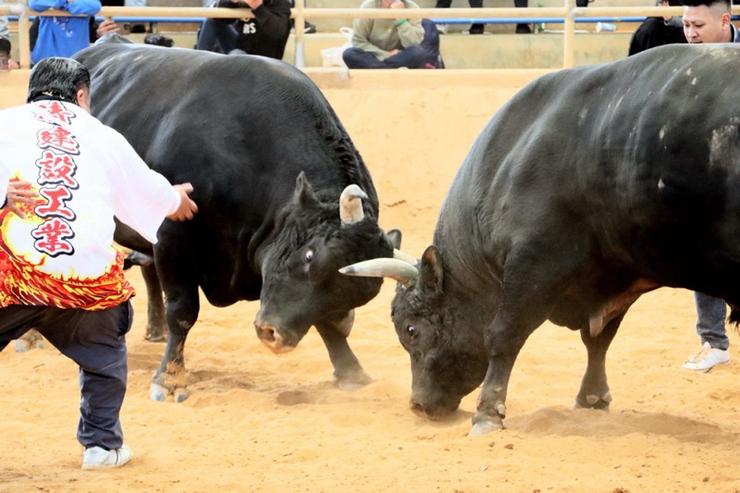
The word “ushiorasee” comes from Okinawan dialect and loosely means “to make bulls fight.” In standard Japanese it’s called tōgyū (闘牛), or sometimes ushi-zumo — “bull sumo.” The name tells you a lot. Unlike the bullfighting you might know from Spain, where a lone matador dances around a bull with a cape before killing it, Okinawan bullfighting is bull-versus-bull. No humans in the ring as combatants. No blood. No death. Just two massive animals locking horns, testing strength and nerve, until one of them decides it’s had enough.
There is, quite literally, only one rule: if you turn your back and run away, you lose.
That simplicity is part of what makes it so compelling. But inside that one rule lives a world of tactics, technique, coaching, relationship, and tradition that locals have spent generations mastering. By the time you finish reading this, you’ll know enough to actually follow what you’re watching — and maybe, like a lot of people who’ve gone once, you’ll find yourself wanting to go again.
📜 A History Carved Out of Okinawa
Bullfighting on Okinawa has roots stretching back at least to the Meiji Era (1868–1912), with the oldest documented match recorded in a local newspaper in 1907 covering fights in the towns of Itoman, Gushikawa, Katsuren, and Yonagusuku. Some accounts push the tradition as far back as the 16th century, when farmers in the Ryukyu Kingdom would gather after a good harvest and pit their working bulls against one another as entertainment. Think of it as the original post-harvest party.
By the early Showa period (1920s–30s), bullfighting had grown so wildly popular that at least one village reportedly had to ban it — not because it was dangerous, but because the men were spending so much time watching and wagering that no one was left to work the fields. That kind of devotion doesn’t happen overnight. It’s the mark of something that’s genuinely found its way into the cultural DNA of a place.
World War II brought everything to a halt. The Battle of Okinawa turned the island into a war zone, and there were no bullfights during the fighting. But within months of the war ending in August 1945, the bouts resumed — a signal, if you needed one, of just how deeply the islanders needed this part of their life back. By the 1950s, formal rules were being codified. By 1965, tournaments were drawing 10,000 spectators to a single event. In 2018, a longtime ban on women entering the ring as handlers was finally lifted.
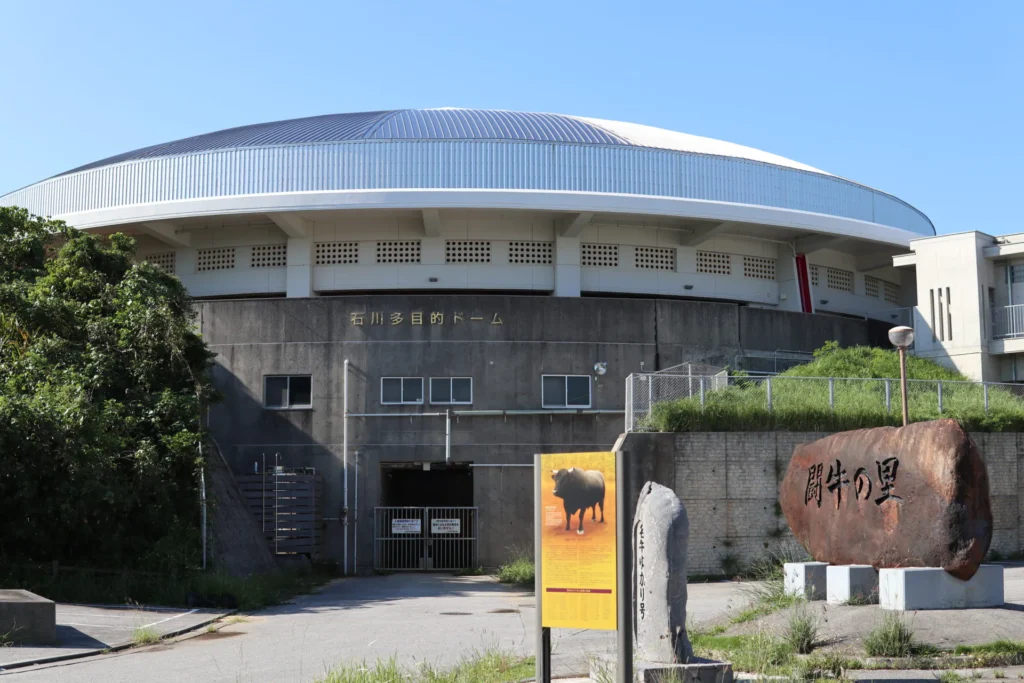
Today, Uruma City — a mid-island city of about 120,000 people — is the undisputed capital of Okinawan bullfighting. The Ishikawa Multipurpose Dome there hosts roughly 20 tournaments every year, and the city proudly carries the informal title of “the City of Bullfighting.” It has been designated an Intangible Folk Cultural Property, which puts it in the same preservation category as classical music, theater, and other living traditions considered worth protecting for future generations.
⚔️ How It Works: The Ring, the Bulls, and the Seko
The Ring
The fighting arena is a circular dirt floor, 20 meters in diameter, surrounded by an iron fence with a single entrance. Everything happens inside that circle. The Ishikawa Multipurpose Dome can accommodate around 4,000 spectators in seating around the ring, and you can get remarkably close to the action. When two 1,000-kilogram animals slam into each other at full force, you feel it in your chest from the front row.
The Bulls
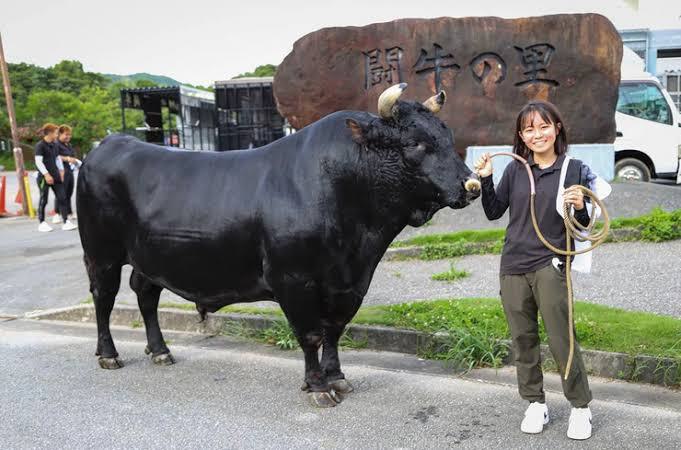
Bullfighting bulls come from all over Japan, not just Okinawa. They are ranked by ability and divided into weight classes — so smaller bulls (around 750 kg) don’t compete against the heaviest (over 1,000 kg). The ranking system mirrors sumo’s, right down to the terminology: the top-ranked bull holds the title of yokozuna, the same word used for sumo’s highest rank. A bull earns that title the same way a sumo wrestler does — by winning, consistently, against the best competition available.
These animals are not simply raised and thrown into a ring. Serious bull owners dedicate significant chunks of their daily lives to their bulls — feeding, cleaning, massaging, training. It’s a relationship built over years, and the bulls know it. Handlers report that a bull fights differently when its primary caretaker is in the ring beside it. The trust between a bull and its human is part of what decides a match.
Techniques
Once you know to look for them, you’ll start seeing the tactics play out in real time. Oshi is a straight forward push — bull hits opponent head-on, trying to drive it backward out of the ring. Wari and tsuki involve using the horns to strike the opponent’s eyebrow area, destabilizing their stance. Kake is a spinning technique where a bull wraps its horns around its opponent’s neck to control the angle of engagement. Motase-komi is a weight technique — the bull leans in and loads its mass onto the opponent, grinding them down. And haratori — one of the most exciting moves to watch — is a flank attack, where a bull pivots to strike the opponent’s side when the opponent’s guard is down. A clean haratori can end a match in seconds.
The Seko: Human Coaches in the Ring
Here’s something most first-timers don’t expect: the bulls aren’t alone in the ring. Each competing bull has a seko — a human handler-coach who stays right beside the animal throughout the match. The seko’s job is to encourage their bull, read the opponent’s movements, and shout tactical cues. They stomp the ground rhythmically and call out “heeyai, heeyai!” to pump up the mood and signal their bull. The verbal cues used to fire up a bull mid-fight are called yagui in Okinawan dialect.

The seko also serves as a safety official. If a bull starts getting too aggressive — if horns risk causing serious injury — the seko physically pulls the animals apart. That’s not a minor detail. The sport’s longevity depends in part on keeping the bulls alive and healthy for the next tournament. Nobody wants their yokozuna coming home with a gored eye.
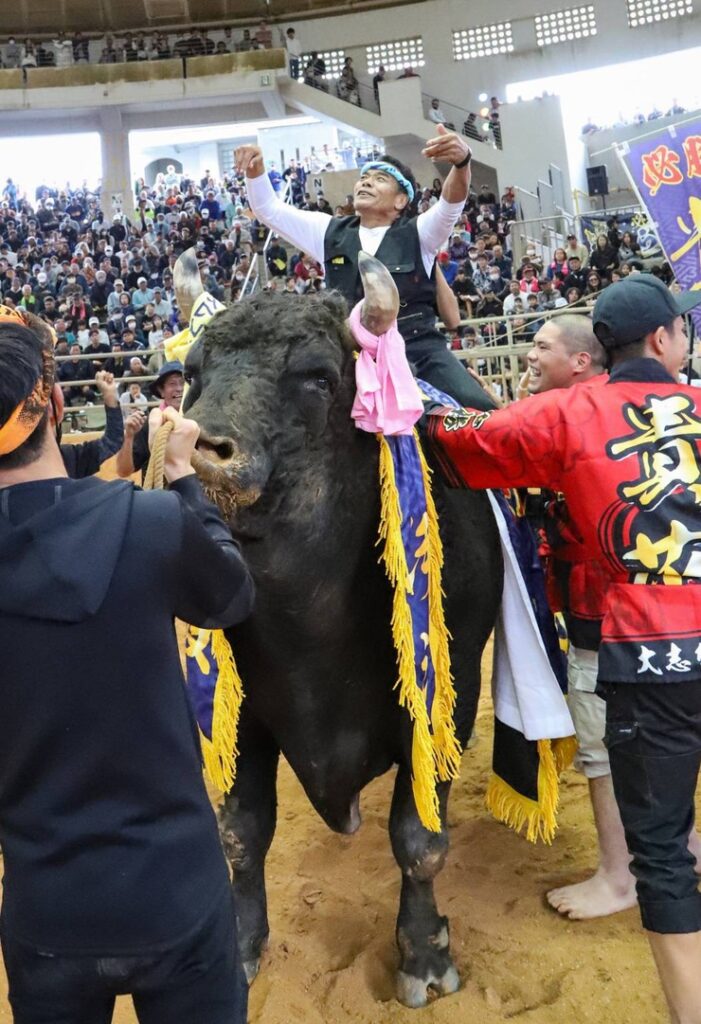
A match ends when one bull submits and retreats, turns its back and walks away, or is struck by a decisive haratori blow that takes it off its feet. Some matches are decided in under ten seconds. Others go on for half an hour. You never quite know which you’re going to get.
❤️ Why It Matters to the Locals
Ask an Okinawan why they love bullfighting and you’re likely to get an answer that sounds like “I don’t know, I’ve just always loved it.” That’s not a non-answer — that’s the whole point. Ushiorasee isn’t something people in Uruma show up to because they’ve decided to appreciate their cultural heritage. They show up because it’s exciting, because their friend owns one of the bulls, because their grandfather took them as a child, because winning feels good and losing hurts and every match feels personal even when it isn’t your bull.
The community structure around bullfighting is tight. Bull owners, handlers, and fans all know each other. Smaller tournaments — which happen far more frequently than the big all-island events — are often organized by individual families, neighborhoods, or associations. The Ginowan Togyu Kumiai (Bullfighting Union) runs one. Various community groups run others. The big-ticket event, the All-Island Bullfighting Tournament, happens three times a year — in May, August, and November — and is essentially Okinawa’s version of a championship bout. The winner of each weight class in that tournament is officially the strongest bull in Okinawa, and that title means something to the people who care about it.
Beyond the competition itself, bullfighting supports an entire ecosystem. Bull ownership is genuinely expensive — daily feed, barn maintenance, veterinary care, training time. People who keep fighting bulls are making a serious lifestyle commitment, not a hobby. The seko relationship — often between a professional trainer and a bull owner — involves trust, strategy, and long-term planning. Bull owners watch replays of past matches to study opponents. They manage their bulls’ energy during training to peak at the right tournaments. It’s more like competitive sports management than a weekend pastime.
For outsiders, that depth is part of what makes attending a tournament so rewarding. You’re not watching an exhibition. You’re watching people who have invested years of their lives into these animals compete in something that genuinely matters to them.
🎟️ Tourism Bullfighting: The Visitor-Friendly Entry Point
Regular tournaments are open to the public, but they can be a lot to take in all at once — especially if you don’t speak Japanese, can’t follow the announcing, and aren’t sure what you’re watching. That’s where the tourism bullfighting program run through togyu.jp comes in. It’s a purpose-built experience for first-time visitors that strips the intimidation factor out without stripping out the substance.
The program runs at the Ishikawa Multipurpose Dome in Uruma City and is organized by Lequio Tourist. Here’s what happens:
🕘 9:00 AM — Reception Opens
Check-in begins at 9:00 AM. Doors to the dome open at 9:30 AM. Free parking is available on site for up to 130 vehicles. No reservation needed — just walk up to the reception desk on the day.
📺 10:00 AM — Opening Act
A short traditional Okinawan performing arts showcase opens the event. The performers vary by date.
🎙️ 10:15 AM — Bullfighting Lecture (300-inch Screen)
Popular local MC Taishi Iha presents a beginner-friendly lecture on the history and culture of bullfighting, projected on a 300-inch screen. Even if your Japanese is limited, the visuals are informative. Iha is known for making the material entertaining and accessible — think less university lecture, more enthusiastic sports broadcast.
🏟️ 10:40 AM — Two Exhibition Matches
Two live bullfighting matches are held. These are exhibition bouts — there’s no official winner or loser — which means the handlers prioritize the experience over the outcome, and you get to watch real bulls doing real fighting without the match-ending stakes. You might find a favorite bull in the ring.
📸 11:00 AM — Photo Time with the Bulls
After the matches, visitors who want to can get a commemorative photo with one of the bulls. This isn’t something you get at a regular tournament — it’s a perk specific to the tourist program. Bring your own camera.
🐄 Add-On: The First-Timer Barn TourA premium add-on program is available for first-time visitors that includes transportation to the bull owners’ barn, a guided care-and-feeding lecture from the bull owner themselves, and a closer look at what daily life with a fighting bull actually looks like. Contact the organizers for details on booking this extra experience.
The whole program runs about 1.5 to 2 hours. The venue is fully indoors, so weather is never a concern — events are held rain or shine. The only exception is a typhoon, in which case cancellations are announced on the official website and social media channels.
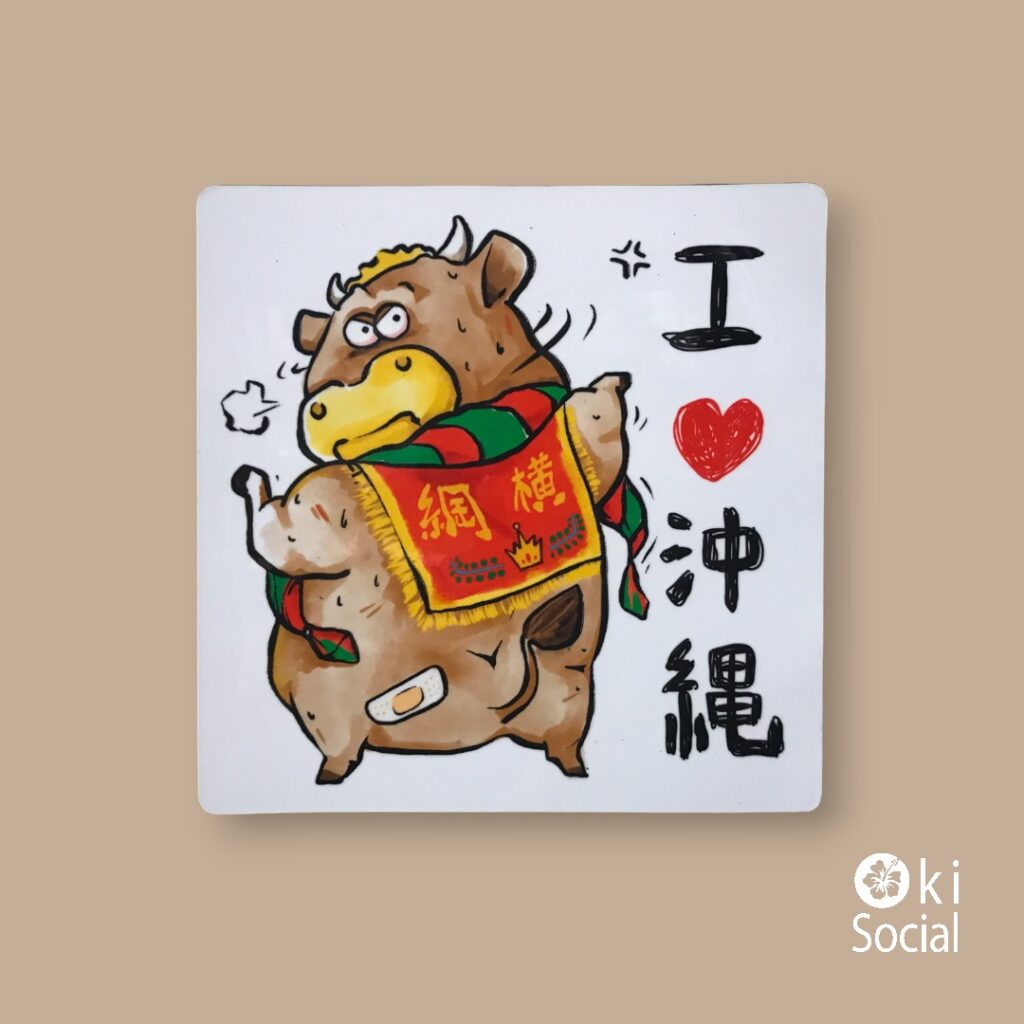
2026 Okinawa Bullfighting Sticker
A champion bull flexing his muscles. How do you know he’s a champion? I mean, look at his guns and the band-aids on his butt. He’s got some dents and scratches, but he stood to the end, and that’s how he rolls.
Now available in the Oki Social Store in the Kadena Exchange and participating stores in Okinawa.
💡 Tips for First-Time Attendees
Tip 1 No reservation required — just show up. This event is walk-in only, no advance booking needed. The venue holds 3,000 people, so there’s plenty of room. Simply arrive and check in at the reception desk on the day.
Tip 2 Arrive by 9:00 AM. Reception opens at 9:00 and doors open at 9:30. The event kicks off at 10:00 with the opening act — getting there early means you won’t miss the lecture, which makes the exhibition matches much easier to follow.
Tip 3 Bring cash. Admission is ¥2,000 for adults and ¥1,000 for children (elementary school and above). Children under elementary school age are free. Having yen ready at the door keeps things smooth.
Tip 4 It’s family-friendly — with a note. The event is great for all ages. That said, exhibition matches can get loud and intense, so younger children should watch alongside a parent or guardian.
Tip 5 Free parking on site — the lot fits up to 130 vehicles. If you’re driving, you won’t need to worry about finding a spot nearby.
Tip 6 Pick up some merch. Bullfighting T-shirts are sold at the venue on event days — regularly ¥3,000, currently available at the introductory price of ¥2,500. Sizes run S through 2XL.
📅 Event Schedule & Logistics
🌟 Upcoming Tourism Bullfighting Events — 2026
The sightseeing bullfighting program at the Ishikawa Multipurpose Dome in Uruma City includes an opening performance, a bullfighting lecture, two live exhibition matches, and optional commemorative photo time with the bulls. No reservation required — just walk in.
Location
📍 Ishikawa Multipurpose Dome — 2298-1 Ishikawa, Uruma City, Okinawa Prefecture
Dates
- 📆 Saturday, May 16, 2026 — Reception 9:00 AM | Doors 9:30 AM | Program 10:00 AM
- 📆 Saturday, June 20, 2026
- 📆 Saturday, July 18, 2026
- 📆 Tuesday, August 11, 2026 (Public Holiday)
- 📆 Monday, September 21, 2026 (Public Holiday)
12 Months of Okinawa Premium Art Print
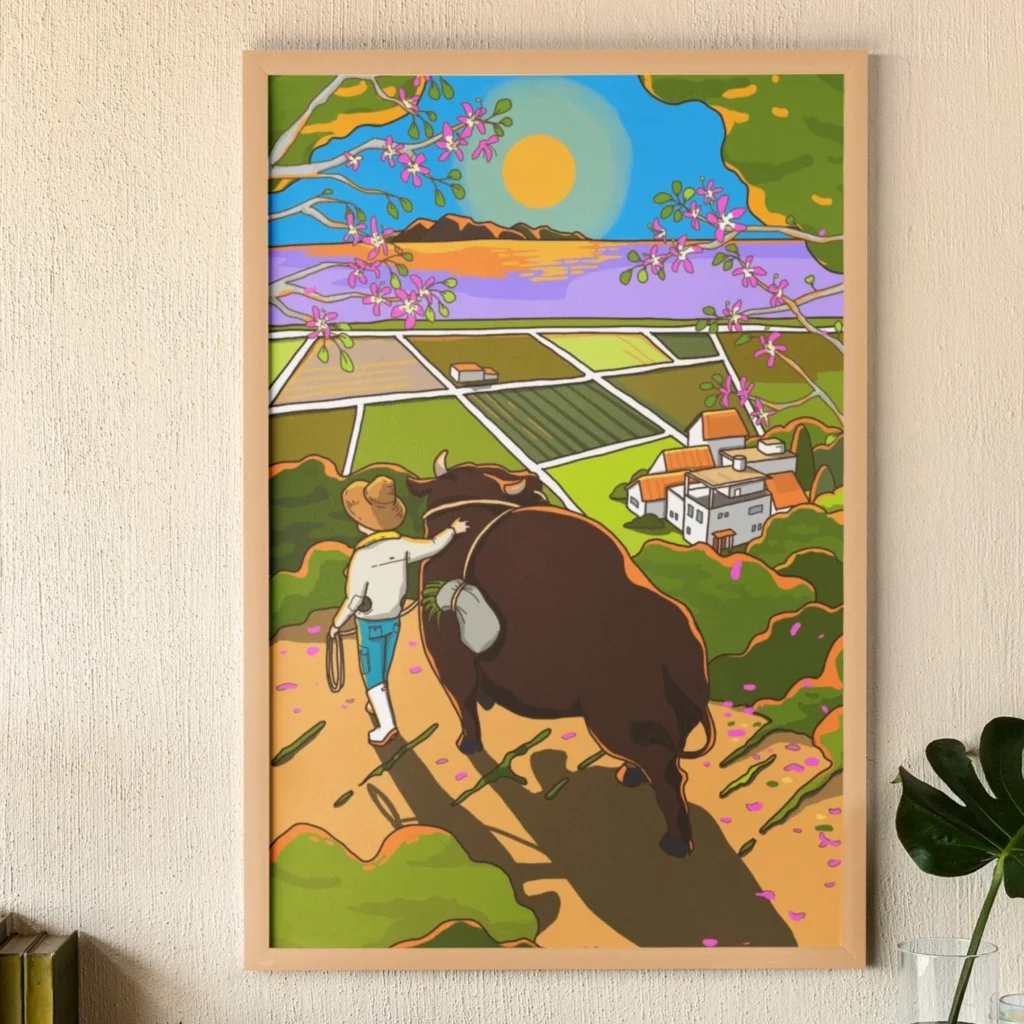
Lend your space a personal touch with a hint of color and character: the November print from the 12 Months of Okinawa collection. This striking image captures a farmer walking his bull at dusk, taking in the view of the field land beneath him. November marks the time when Okinawa’s Jamaica cherries come into full bloom, and this portrayal shows several of them still adorning the branches while the sun sets in the background.
Now available in the Oki Social Store in the Kadena Exchange.
🙋 Q&A
Q: Can I make an advance reservation?
A: No advance reservation is required for this event. The venue can accommodate 3,000 people, so please check in at the venue on the day of the event.
Q: Is there parking available?
A: Yes, there is free parking at the venue. It can accommodate up to approximately 130 vehicles.
Q: Can I attend with children?
A: Of course! Bullfighting is a family-friendly event. However, since the exhibition matches can be quite intense, we ask that children watch alongside a parent or guardian.
Q: Will the event be held even if it rains?
A: The venue is a dome, so the event goes ahead rain or shine. However, it may be cancelled during a typhoon for safety reasons. Cancellations will be announced on the official SNS accounts and website.
Q: How do I participate in the commemorative photo time?
A: Commemorative photo time is optional and open to anyone who wishes to join. Staff on the day will guide you through it — just follow their instructions when the time comes.
Q: Where can I purchase tickets?
A: Tickets can be reserved in advance through this website. You can also purchase them at the venue on the day of the event, though crowds are expected so advance online reservation is recommended. Tickets are also available at select FamilyMart convenience stores in Uruma City, Onna Village, and Kin Town.
Q: How do I get to the venue?
A: Access by car or public transportation is convenient. Detailed directions and access information are available on the website at togyu.jp.
🎯 Should You Go?
If you’re new to Okinawa — whether you’re a tourist here for a week or military personnel trying to figure out what the island actually is when you leave the base — bullfighting at the Ishikawa Multipurpose Dome is the kind of experience that answers that question. It’s loud, it’s physical, it’s local, and it has almost nothing to do with the Okinawa that gets marketed to outsiders. No souvenir shisa dogs. No tropical cocktails with little umbrellas. Just the island’s oldest living sporting tradition, still breathing, still drawing crowds, still producing people like Hiroma Kamiyama who wake up at 5 AM every day because they believe in their bull.
Go for the tourism program if it’s your first time — the lecture and the exhibition matches will give you the context to actually appreciate what you’re watching. Then, if you find yourself wanting more, go back for a real tournament. The All-Island Championship in May, August, or November is the peak experience. But honestly, any afternoon at that dome is worth it. Put it on the calendar, and while you’re at it, check okisocial.com/events for more local events happening on the island this week.
Information and photo source: https://togyu.jp/
Don’t Miss This Seasonal Event in Okinawa Now
Disclaimer
⚠️Disclaimer: Our passion for supporting local businesses drives us to share information about events in the Okinawa area. Please note that Oki Social is not responsible for hosting this event. It’s important to be aware that the event’s host reserves the right to make changes or even cancel the event without prior notice. Some photos and videos may come from various sources on the internet, whether official or unofficial. It is possible that some photos and videos may have been taken from the same event in previous occurrences.